What Are the Types of Swing Automatic Doors?
Swing automatic doors do more than open a passage; they shape how people move through hospitals, offices, shops, and hotels. Their choice affects clear opening width, traffic flow, accessibility, and maintenance. The MarketsandMarkets report Automatic Door Market forecasts growth from USD 22.6 billion in 2023 to USD 32.8 billion by 2028. The estimate covers several automatic-door types, not swing doors alone, so it should be read in context. Still, it reflects wider investment in automated entrances. Small details matter.
This guide explains the main types of swing automatic doors, including single-leaf and double-leaf systems, low-energy and full-power operators, and configurations with breakout features. Some doors are mounted on the surface; others use concealed operators above the frame. These options are not interchangeable. A busy clinic entrance may need different opening speed and safety sensors than a quiet office corridor. Selection should account for pedestrian volume, door weight, available space, and the needs of people using mobility aids. Manufacturer specifications and relevant accessibility and safety requirements should be checked before installation. Real sites can be less tidy than product diagrams suggest. That distinction matters. Understanding the types of swing automatic doors makes it easier to compare systems, ask informed questions, and identify where expert assessment is needed.
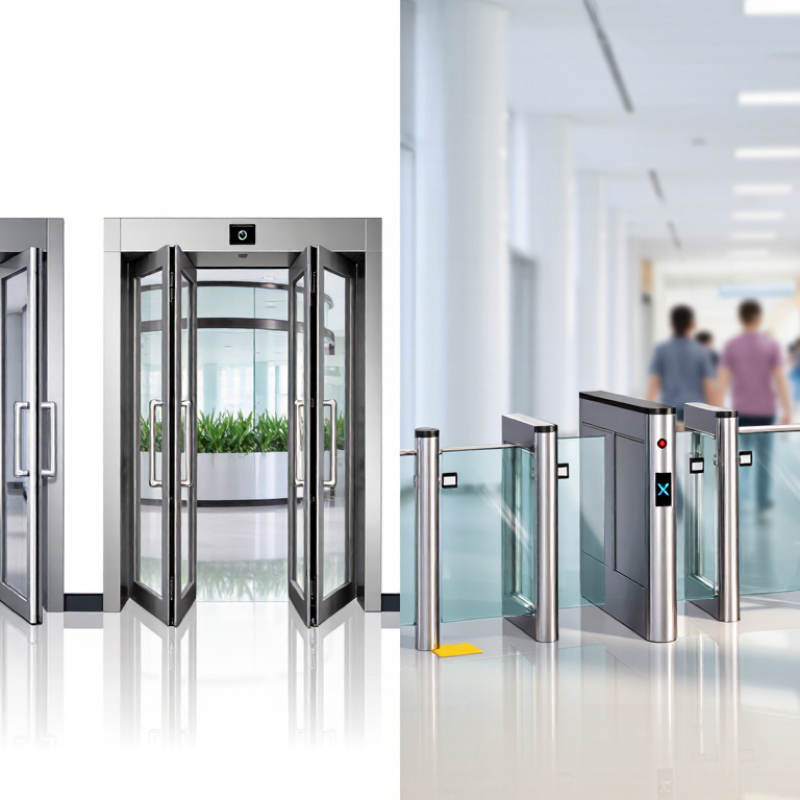
Swing Automatic Doors Classified by Number of Door Leaves
What Are the Types of Swing Automatic Doors?
Swing Automatic Doors Classified by Number of Door Leaves
By leaf count, swing automatic doors are generally single-leaf or double-leaf systems. A single-leaf door has one moving panel, so its opening direction and nearby wall space matter. Picture a narrow corridor: the panel needs room to swing without striking a cart, person, or adjacent fixture. This layout is often straightforward to plan, but it can restrict the clear passage width.
A double-leaf system uses two panels, which may be equal or unequal in width. Equal leaves create a balanced opening; unequal leaves can provide a wider active panel for everyday traffic while the second stays closed. The U.S. Access Board’s 2010 ADA Standards, section 404.2.3, specify a 32-inch minimum clear opening for applicable accessible doorways, measured with the door open 90 degrees. That measurement refers to usable space, not the combined panel widths. Small detail. For paired doors, hardware and the inactive leaf can affect the actual opening.
Leaf count alone does not determine suitability. Designers also check traffic volume, approach space, emergency egress needs, and how the door interacts with wheelchairs or rolling equipment. A double-leaf arrangement may ease busy two-way movement, yet it needs room for both panels to swing. A single leaf may fit a tight vestibule better, though queues can form at peak times. The trade-off is easy to underestimate. Measure the clear opening on site, and verify applicable local accessibility requirements before selecting a configuration.
Swing Automatic Doors by Number of Door Leaves
A single-leaf swing door has one door leaf. A double-leaf swing door has two leaves that operate as a pair.
Types Based on Operating Speed and Power
Types Based on Operating Speed and Power
Swing automatic doors are commonly grouped as low-energy, power-assisted, or full-power systems. Low-energy operators move the door slowly and are often chosen for quieter corridors or locations where users approach close to the door. Power-assisted models help with opening but still rely on the user to start the movement. Full-power doors open and close automatically at higher speeds, so sensors and carefully adjusted safety settings are essential. The distinction is practical: a fast door can improve traffic flow, but it also needs more careful site assessment.
For technical criteria, consult ANSI/BHMA A156.19 for power-assist and low-energy operators, and ANSI/BHMA A156.10 for full-power operators. These standards set measurable requirements for operation, timing, and safety; they do not make every installation identical. Door width, weight, hinges, and wind pressure can all affect performance. A technician should test the installed door, not just rely on its catalogue rating. A heavy door may feel sluggish even when its operator is working as intended. Speed alone is a poor selection metric.
Tips: Ask for the applicable standard and the measured opening time during commissioning. Watch the door from the approach side, especially where a wheelchair user might pause. Small adjustments matter. Recheck settings after changes to flooring, weather seals, or nearby traffic patterns.
Types Based on Operator Design and Installation
Swing automatic doors are commonly classified by operator location and the way the mechanism moves the door leaf. A surface-mounted overhead operator sits above the frame. It may use an articulated arm or a slide-track arm to push or pull the door. The unit remains visible, but technicians can usually inspect it without opening the header. This arrangement can work well for retrofits when the frame is strong enough and has adequate clearance.
A concealed overhead operator fits inside a header or transom, creating a cleaner appearance. It requires accurate measurements and enough space for the mechanism, wiring, and service access. Floor-mounted operators sit below the threshold and drive the door from its pivot. They may suit certain heavy doors, but floor structure and drainage need careful assessment. Placement alone does not determine performance. Door weight, width, hinge condition, traffic, and opening direction also matter. A strong operator cannot fix a weak frame. That matters. Installers should check clearances, manual movement, and the closing path before selecting the operator and arm. Concealment looks neat, though service access is easy to underestimate.
What Are the Types of Swing Automatic Doors? - Types Based on Operator Design and Installation
| Classification |
Type |
How It Works / Typical Installation |
Typical Uses |
Key Considerations |
| Operator design |
Electromechanical operator |
An electric motor drives a mechanical transmission, such as gears or a linkage, to open and close the door. It is commonly fitted above the door or within a header. |
Commercial entrances, offices, healthcare spaces, and other locations requiring automated swing-door operation. |
Check door size and weight limits, duty cycle, available power, and whether the operator supports the required access and safety devices. |
| Operator design |
Electrohydraulic operator |
An electric motor powers a hydraulic system that controls door movement. The operator is usually installed above the door or in a header assembly. |
Some commercial and institutional applications where a controlled swing and closing action is needed. |
Confirm the unit’s operating requirements and maintenance needs. Availability and design details vary by operator model. |
| Installation |
Surface-mounted overhead operator |
The operator is mounted visibly on the door frame or adjacent wall above the opening. An arm connects the operator to the door leaf. |
Retrofits and new installations where accessible mounting space is available above the opening. |
The frame and surrounding structure must support the operator. Arm type and position depend on the door swing and mounting geometry. |
| Installation |
Concealed overhead operator |
The operator is hidden within a header, transom, or other overhead enclosure, with the door connected through a suitable mechanism. |
Projects where a less visible installation is preferred and the opening can accommodate the required enclosure. |
Plan for adequate enclosure dimensions, access for servicing, compatible door construction, and structural support. |
| Installation |
Floor-concealed operator |
The operator is installed in a floor box beneath or near the door pivot, with the drive connected to the door at floor level. |
Selected new-build or major-renovation projects where an overhead operator is unsuitable or a concealed appearance is desired. |
Requires careful coordination with the floor structure, drainage and moisture conditions, finished floor level, and future maintenance access. |
| Installation |
Jamb- or frame-integrated operator |
The operator is fitted within or alongside a door jamb or frame assembly. The exact arrangement depends on the frame and operator design. |
Specialized installations where the frame can accommodate the operator and its drive components. |
Verify compatibility with the frame, door handing, clear opening, wiring route, and servicing requirements before construction or retrofit. |
Note: Operator configurations and permitted applications vary. Selection should account for the door and frame, traffic level, accessibility requirements, safety sensors, and applicable local codes.




 Automatic Doors, Inc.