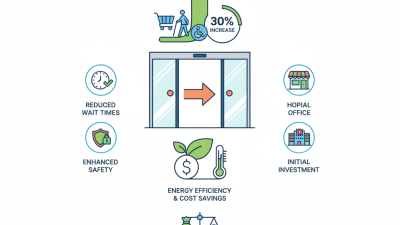
Choosing power doors for an international facility involves more than comparing prices and photographs. The right model must match traffic levels, building conditions, safety expectations, and local installation capabilities. A warehouse door may open hundreds of times daily, while a cleanroom entrance may require smoother movement and tighter environmental control. Small differences matter.
These seven buying tips help global buyers examine the complete purchase, not just the door panel. They cover opening speed, motor durability, sensor performance, operating voltage, weather resistance, documentation, and after-sales support. Ask for cycle-test data. Request clear wiring diagrams. Confirm whether replacement parts are available near the installation site. A reliable supplier should explain limitations, not promise perfection.
A low quote can look attractive. It may also exclude shipping, commissioning, training, or compatible control accessories. That detail is easy to miss. Experienced procurement teams compare total ownership costs across several years. They also check whether the proposed power doors suit the actual doorway, floor level, wind exposure, and daily workflow. Product certifications and technical claims should be independently reviewed against applicable regional requirements. Still, specifications alone cannot predict every site problem. Dust, temperature changes, rushed installation, or limited maintenance skills can affect performance. Careful buyers leave room for those realities and build questions into every supplier discussion.
Power doors are not interchangeable. Sliding doors suit supermarkets, airports, and wide entrances with steady traffic. Swing doors work better in clinics, offices, and corridors with limited space. Revolving doors can separate indoor and outdoor air, but they require careful accessibility planning. Low-energy operators support users who need assistance without creating unnecessary movement.
The World Health Organization reported in 2023 that 1.3 billion people experience significant disability worldwide. That figure makes accessible entry design a practical requirement, not a decorative feature.
The GlobalABC 2023 report also states that buildings consume about 30% of global final energy. A properly selected door can help manage airflow, although savings depend heavily on climate, installation, and user behavior.
One mistake I have seen is choosing a fast door for a slow, narrow corridor. It looked efficient, but users felt rushed. Specifications rarely capture that human detail.
7 Power Doors Buying Tips for Global Buyers
Global buyers should treat safety evidence as a purchasing requirement, not a decorative file. Ask for current test reports, conformity documents, and installation instructions. Check whether testing covers the exact door size, sensor layout, and operating speed. Standards such as EN 16005, ANSI/BHMA A156.10, and ISO 21542 may be relevant, but local requirements still control the final decision. A certificate may cover only one configuration. That detail is easy to miss.
Accessibility needs practical checking. Measure the clear opening with the door fully open. Test it with a wheelchair, walking aid, or loaded cart. The control button should be reachable, visible, and simple to operate. Keep enough space beside the door for turning and waiting. Watch the closing cycle carefully. It should reopen when a person or object enters the sensor zone. Do not trust a brochure alone.
Power failure tests matter too. Ask how the door behaves during an outage, emergency release, or sensor fault. Inspect warning labels and manual operation points on site. In one assessment, a door passed the basic opening test but felt too slow for busy traffic. That result deserved a second review. Conditions change. Rain, dust, temperature, and heavy daily use can affect performance. Record the test results, request maintenance intervals, and confirm that local technicians can support the chosen system. Reliability is demonstrated at the doorway, not only in a document.
| No. | Buying Tip | What to Check | Relevant Standards or Regulations | Practical Requirement or Benchmark | Documents and Evidence to Request |
|---|---|---|---|---|---|
| 1 | Identify the Door Category and Intended Use | Confirm whether the product is a sectional door, rolling door, sliding door, hinged door, industrial door, garage door, gate, or pedestrian automatic door. Define indoor or outdoor use, traffic frequency, dimensions, weight, wind exposure, and temperature range. | EN 13241; EN 12453; EN 16005; UL 325; applicable national building and electrical codes. | The operator, door leaf, controls, sensors, and safety devices should be assessed as one complete powered-door system rather than as unrelated components. | Product classification, intended-use statement, technical datasheet, dimensional drawings, load calculations, duty-cycle rating, and environmental operating limits. |
| 2 | Verify the Correct Safety Standard | Check that the standard applies to the complete door assembly and the destination market. Confirm requirements for crushing, shearing, impact, entrapment, emergency release, and unintended movement. | EN 12453 covers safety in use for power-operated doors, gates, and barriers. UL 325 addresses safety requirements for door, gate, curtain, window, and louver operators in its applicable market. | The safety concept should include obstruction detection, suitable protective devices, controlled stopping or reversal, and protection against access to hazardous moving parts. | Test reports, risk assessment, safety-function description, wiring diagrams, protective-device specifications, and installation instructions identifying the standards used. |
| 3 | Check Market-Entry Certifications and Declarations | Determine whether the destination requires a conformity declaration, third-party listing, electrical approval, radio approval, or local registration. Do not treat a logo alone as proof of compliance. | CE marking may be required for applicable European Union legislation. UKCA may apply in Great Britain. UL, CSA, or other nationally recognized certification schemes may apply depending on the market and product type. | Certification scope should match the exact model, voltage, operator, door configuration, and safety accessories being purchased. | Signed declaration of conformity, certificate or listing file, applicable test reports, technical construction file summary, electrical ratings, and certification mark instructions. |
| 4 | Confirm Electrical Safety and Site Compatibility | Match supply voltage, frequency, phase, earthing, enclosure rating, cable requirements, backup power, and emergency operation with the installation site. | IEC 60204-1 for electrical equipment of machines may be relevant. IEC 60335-2-103 covers particular requirements for drives for gates, doors, and windows in its applicable scope. Local electrical codes also apply. | The electrical design should provide protective earthing or approved double insulation, overcurrent protection, safe isolation, and clearly documented emergency release procedures. | Electrical schematic, rated input data, ingress-protection rating, EMC information, installation method, circuit-protection requirements, and emergency-release test procedure. |
| 5 | Evaluate Accessibility and Usability | Check clear opening width, threshold, opening and closing speed, activation method, control location, visibility, manual effort, and access for wheelchair users and people with limited mobility. | ADA 2010 Standards may apply in the United States. EN 17210 provides accessibility and usability principles for the built environment. EN 16005 applies to power-operated pedestrian doors in its scope. | Under ADA provisions, accessible doors generally require at least a 32-inch clear opening. Controls should be placed within the applicable reach range, and local accessibility rules must be checked for maneuvering clearances and operating forces. | Opening-size drawing, accessibility compliance statement, activation-zone details, control heights, threshold data, operating-force measurements, and commissioning records. |
| 6 | Review Installation, Testing, and Maintenance Duties | Establish who is responsible for installation, commissioning, inspection, periodic testing, repairs, software updates, and replacement of safety devices. | EN 12635 addresses installation, use, and maintenance information for industrial, commercial, and garage doors and gates. ISO 12100 provides principles for machinery risk assessment and risk reduction. | Safety devices should be tested after installation and following changes, damage, or repairs. Maintenance intervals should reflect traffic volume, environment, and manufacturer instructions. | Installation manual, commissioning checklist, maintenance schedule, inspection forms, spare-parts list, training records, and documented risk assessment. |
| 7 | Compare Lifecycle Cost and Import Conditions | Compare purchase price with installation, customs duties, testing, local adaptation, energy use, consumables, service access, downtime, and end-of-life disposal. | Applicable customs, product-safety, radio-equipment, electromagnetic-compatibility, environmental, and waste regulations vary by destination country. | A lower initial price may create higher costs if replacement parts, qualified service personnel, compatible safety sensors, or local compliance documents are unavailable. | Delivered-cost quotation, harmonized tariff classification support, warranty terms, spare-parts availability period, response-time commitment, service network details, and product end-of-life information. |

Note: Standards and accessibility requirements can vary by country, building type, and door application. Buyers should confirm the current edition and legal applicability with the local authority, qualified installer, or conformity-assessment body before purchase.
Material choice should follow the site, not the brochure. Galvanized steel suits heavy traffic and impact risks. Aluminum reduces weight and resists many humid environments. Insulated panels help stabilize indoor temperatures, especially in cold storage or conditioned warehouses.
Ask for corrosion data, panel thickness, and tested thermal performance.
A shiny finish proves little.
Safety sensors should detect a person, pallet, or small obstacle. Confirm performance against applicable standards, such as EN 12453 or local electrical codes.
The International Energy Agency reports that buildings consume about 30% of global final energy.
Poorly sealed doors can waste conditioned air during repeated openings. Insulation matters, but operating frequency matters too. Request measured air-leakage and cycle-energy data, not vague efficiency claims.
A door opening 500 times daily needs different hardware than one opening 40 times.
Ask for maintenance intervals and replacement-part availability in your region.
Faster is not always better. Excessive speed can increase wear, noise, and safety concerns.
My practical mistake was comparing purchase prices before calculating downtime. That approach looked efficient, but it ignored labor, lost temperature control, and repair delays.
Collect at least twelve months of expected cycles before choosing the motor and control system.
Buying a power door is not just a price decision. Supplier reliability matters more.
The World Health Organization reports that 1.3 billion people, or 16% of the global population, experience significant disability. This makes accessibility performance a practical requirement, not a marketing feature. Ask suppliers for test records, installation references, compliance documents, and clear maintenance procedures. A factory visit can reveal more than polished photographs.
Customization should cover opening width, traffic frequency, climate, security controls, and emergency operation. Confirm which changes are standard and which require engineering approval. Request drawings before production.
Small errors in sensor position can cause repeated false openings. Test it locally. I have seen projects delayed because a “simple” voltage change required new control equipment. That mistake was avoidable.
Warranty language deserves equal attention. Check coverage periods, excluded parts, labor terms, response times, and procedures for overseas claims.
The International Facility Management Association identifies reactive maintenance as a major operational burden, so preventive service planning should be agreed before shipment. Ask whether spare sensors, rollers, batteries, and controllers will remain available for several years. A low purchase price can become expensive without support.
Require remote troubleshooting, local technician training, and written escalation contacts. The 2023 World Bank Logistics Performance Index also shows that shipment reliability varies widely between markets. Build buffer time into installation plans.
Suppliers may promise everything; documentation proves little. Reference checks remain essential.
7 Power Doors Buying Tips for Global Buyers
Planning Global Shipping, Installation, Maintenance, and Total Costs
A power door can look affordable until shipping, site preparation, and commissioning are added. Confirm the packed dimensions, gross weight, crate materials, and destination port before placing an order. Ask for a commercial invoice, packing list, installation drawings, and spare-parts list. These documents reduce customs delays and prevent costly surprises. Small details matter.
Tip 1: Calculate the landed cost, not only the equipment price. Include ocean or air freight, insurance, import charges, local delivery, lifting equipment, electrician fees, and storage. Exchange rates can also change the final amount. A written cost sheet helps, although estimates are never perfect.
Tip 2: Check installation conditions before shipment. Measure the opening, floor level, wall strength, drainage, and available power supply. Confirm voltage and control requirements with a qualified local technician. In cold, humid, dusty, or coastal locations, protection levels and corrosion-resistant materials deserve careful review. A beautiful door may fail when the site is unprepared.
Tip 3: Plan maintenance from day one. Request service intervals, troubleshooting instructions, wiring diagrams, and recommended replacement components. Keep common sensors, seals, rollers, and control parts nearby when downtime is expensive. Maintenance quality often depends more on training than equipment price. This is easy to underestimate.
Ask who will inspect the door after installation and how faults will be documented. Clear acceptance criteria should cover speed, safety sensors, noise, emergency operation, and repeated cycling. A low initial quote can hide higher operating costs. Compare the complete ownership plan over several years.