Choosing the best power doors for your business is not simply a matter of selecting the fastest operator. It is a decision about safety, accessibility, traffic flow, energy use, and long-term maintenance. A hospital entrance faces different demands from a hotel lobby or a warehouse loading area.
Market reports indicate steady growth in the automatic door sector. MarketsandMarkets projects the global automatic door market to expand from approximately USD 7.4 billion in 2023 to USD 10.4 billion by 2028. Grand View Research also identifies rising accessibility requirements, smart-building investment, and energy efficiency as major market drivers. These figures are useful, but they do not choose a door for your site.
“Performance begins with understanding the opening, not selling the product,” says Richard Morgan, an automatic-door industry consultant. His point deserves attention. A power doors system may look impressive, yet perform poorly when paired with heavy traffic, narrow circulation space, or weak service support.
Watch the entrance during peak hours. Count queues, carts, wheelchairs, and delivery movements. Then consider activation sensors, opening speed, emergency release, weather sealing, and noise levels. Standards such as EN 16005 and ANSI 156.10 provide valuable safety guidance, but local requirements still need professional verification.
A perfect choice rarely exists. Some businesses may overestimate smart controls and underestimate maintenance access. That mistake becomes expensive when a door fails during a busy morning. The strongest decision balances compliance, daily experience, total cost, and dependable support.
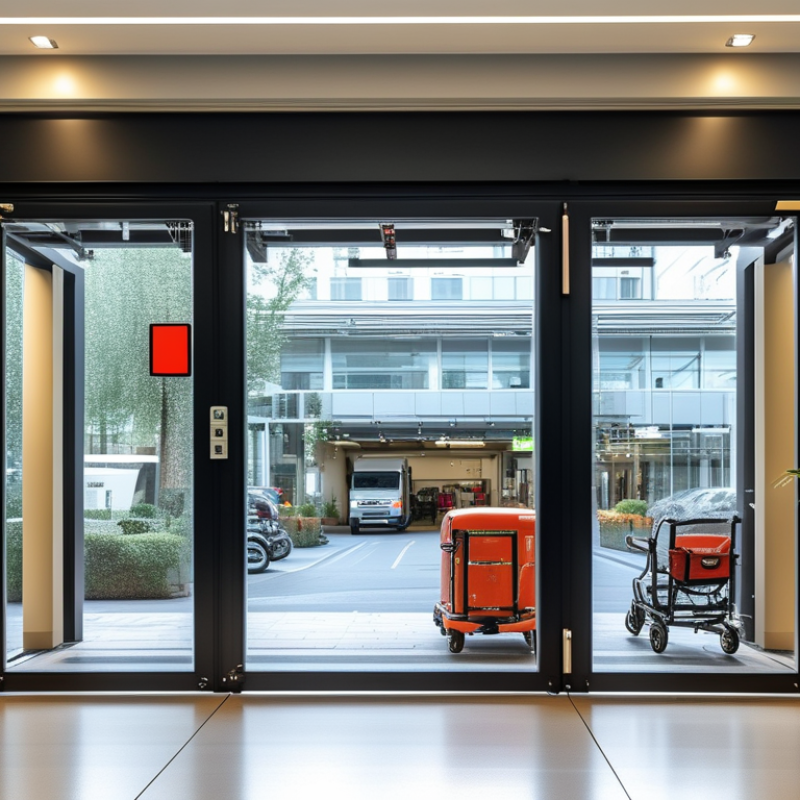
Power doors are not simply doors with motors. They combine an opening system, sensors, controls, and safety devices. Their best business application depends on movement, users, and building conditions.
The World Health Organization’s Global Report on Health Equity for Persons with Disabilities estimates that 1.3 billion people experience significant disability worldwide. This makes accessible entry design a business responsibility, not a decorative upgrade. Sliding doors suit hospitals, supermarkets, and busy offices because they preserve clear passage space. Swing operators can work well in smaller corridors or controlled office entrances. Warehouses often need stronger systems, wider openings, and protection from dust or temperature changes.
Traffic data should guide the choice. Count arrivals during peak periods, then observe carts, wheelchairs, deliveries, and emergency movement. The U.S. Energy Information Administration’s Commercial Buildings Energy Consumption Survey recorded about 6.2 million commercial buildings in the United States, showing how varied business facilities can be. A small clinic and a distribution site should not share the same specification. That sounds obvious.
Check activation distance, closing speed, safety sensors, manual operation, and maintenance access. Standards such as ANSI/BHMA A156.10 provide useful performance guidance for power-operated pedestrian doors. In practice, a door can pass a specification review yet perform poorly when sunlight blinds sensors or winter air changes user behavior. I would also question energy claims unless they include traffic volume, climate, and actual operating schedules. A reliable selection includes technician training, inspection records, and a replacement plan for critical components.
| Power Door Type | Typical Business Application | Typical Opening Speed | Main Advantages | Key Selection Factors | Best Fit |
|---|---|---|---|---|---|
| Automatic Sliding Door | Retail entrances, offices, hotels, healthcare facilities, and public buildings | Approximately 0.2–0.7 m/s, depending on configuration and safety settings | Hands-free access, smooth traffic flow, wide clear opening, and strong accessibility performance | Available wall space, pedestrian volume, weather exposure, sensor coverage, and emergency egress requirements | Businesses requiring convenient, high-frequency pedestrian access |
| Automatic Swing Door | Small offices, clinics, restaurants, schools, and interior corridors | Typically 3–5 seconds for a full opening cycle, subject to door width and safety settings | Suitable for existing hinged doors, comparatively simple installation, and effective accessibility support | Door weight, hinge condition, opening force, available maneuvering space, and traffic direction | Sites where replacing the existing door is impractical or space is limited |
| Automatic Revolving Door | Hotels, office towers, shopping centers, and large commercial entrances | Rotational speed is generally controlled for safe, continuous pedestrian movement | Helps limit uncontrolled air exchange, supports entrance comfort, and handles steady two-way traffic | Building frontage, accessibility provisions, emergency breakout design, climate, and expected traffic volume | High-profile entrances where comfort and continuous traffic management are priorities |
| High-Speed Fabric Door | Warehouses, logistics facilities, manufacturing areas, and loading zones | Often about 0.8–2.5 m/s, depending on door design and operating conditions | Reduces the time an opening remains exposed, supports workflow, and can help separate environmental zones | Cycle frequency, wind exposure, impact resistance, temperature control, clear dimensions, and maintenance access | Industrial operations with frequent vehicle or equipment movement |
| Automatic Sectional Overhead Door | Distribution centers, service garages, workshops, and industrial storage buildings | Commonly about 0.2–0.5 m/s, depending on panel weight and drive system | Provides security, weather resistance, insulation options, and efficient vertical operation | Ceiling clearance, panel construction, thermal requirements, vehicle dimensions, wind load, and cycle count | Vehicle and material access where overhead space is available |
| Automatic Roll-Up Door | Retail stockrooms, warehouses, commercial kitchens, and compact service openings | Approximately 0.2–1.5 m/s, depending on curtain material and duty rating | Space-efficient, adaptable to many opening sizes, and available with security or visibility options | Opening size, cycle frequency, security level, wind resistance, insulation, and available headroom | Businesses needing a compact door solution for goods or service access |
| Low-Energy Power-Assisted Door | Small offices, community facilities, assisted-living centers, and low-traffic entrances | Deliberately controlled speed to support safe pedestrian access | Improves accessibility while retaining manual use and generally suits lower traffic levels | User needs, door resistance, activation method, safety sensors, and applicable accessibility rules | Locations needing occasional powered assistance rather than continuous automatic operation |

 Automatic Doors, Inc.