Choosing the best home doors for any climate involves more than matching paint, style, or price. A door faces heat, rain, snow, wind, humidity, and daily use. Its performance can affect comfort, energy bills, security, and maintenance.
Home improvement expert Lou Manfredini has said, “A door must work for the climate it lives in.” That principle guides this article. In a humid coastal area, fiberglass or well-sealed composite doors can resist swelling and moisture damage. In colder regions, insulated steel or fiberglass doors may reduce drafts around the entryway. Hot, sunny locations require durable finishes and careful attention to heat gain.
Small details matter. Check the door’s U-factor, air-leakage rating, weatherstripping, threshold, and frame construction. A beautiful door can still perform poorly if its installation leaves a narrow gap beneath the sill. You may feel that draft on a windy evening.
Material is only part of the decision. Local exposure matters too. A sheltered porch needs different protection from an entrance facing driving rain. Professional installation also deserves attention, because even a high-quality door can fail when the frame is uneven or poorly sealed.
There is no perfect door for every home. That is worth admitting. Climate data, building design, budget, and maintenance habits all influence the final choice. This guide compares practical options, explains key performance ratings, and identifies mistakes homeowners often overlook before buying home doors.
How to Choose the Best Home Doors for Any Climate?
Start with the U.S. Department of Energy climate zone map. It divides regions from hot Zone 1 to very cold Zone 8. These zones reflect heating and cooling demand, but they cannot describe every property accurately. Moisture, wind, elevation, and shade can change a door’s real exposure.
Check local weather records for at least ten years. Look for winter lows, summer humidity, wind-driven rain, snowfall, and freeze-thaw cycles. A coastal home may need corrosion-resistant hardware and carefully sealed edges. A dry, sunny location may need stronger protection against ultraviolet damage and shrinking materials. A shaded entrance often stays damp longer than the climate map suggests.
Walk around the house after heavy rain. Notice whether water reaches the threshold or blows against the hinge side. Inspect the existing frame for swollen wood, cracked sealant, or daylight beneath the door. These details often matter more than a general regional label. Choose a well-insulated door for severe heating or cooling loads, then match it with continuous weatherstripping and a properly adjusted threshold. Ask a local building professional to verify installation requirements and emergency egress rules. Climate zones guide decisions; local evidence corrects them. I would not rely on a map alone.
Define climate exposure using U.S. DOE climate zones and local weather data. The chart compares representative annual heating and cooling degree days (base 65°F), showing the thermal demands doors may need to withstand.
Heating Degree Days (HDD) indicate heating demand, while Cooling Degree Days (CDD) indicate cooling demand. Values are rounded representative 1991–2020 climate-normal estimates for major U.S. locations. DOE climate zones range from 1A (very hot-humid) to 7A (very cold).
An NFRC label turns door performance into measurable evidence. U-factor shows how quickly heat passes through the door assembly. Lower values generally reduce heat transfer. A cold-climate home usually benefits from a lower U-factor. The U.S. Department of Energy’s Energy Saver guidance reports that windows account for about 25–30% of residential heating and cooling energy use. Doors add less area, but weak insulation can still create a cold strip near the floor. Small detail. NFRC 100 procedures provide the foundation for certified U-factor ratings.
SHGC measures how much solar heat enters through glazed door areas. Lower SHGC can limit summer overheating, especially on west-facing entrances. A higher SHGC may help sunny, heating-dominated locations during winter. That choice is not universal. NFRC 200 defines the solar-heat-gain rating method, while NFRC 400 addresses air leakage. Air leakage is reported in cubic feet per minute per square foot at a standard pressure. Lower leakage usually means fewer drafts and less uncontrolled energy loss.
Compare the entire door assembly, not only the glass. Check the frame, sill, weatherstripping, and installation details. A certified low-U-factor door can perform poorly when the sill is uneven. I have seen specifications look impressive, yet field sealing remained the weak point. Climate data should guide the decision, but exposure matters too. Wind-driven rain, shade, and afternoon sun can change the practical result. NFRC ratings are useful evidence, not a substitute for careful installation.
How to Choose the Best Home Doors for Any Climate?
Climate should guide your door material more than appearance. In humid regions, choose fiberglass, treated wood, or corrosion-resistant metal with sealed edges. Moisture can swell untreated wood and damage weak thresholds. Inspect water-penetration ratings and confirm that the door passed independent laboratory testing. Small gaps become obvious during heavy rain.
In hot climates, prioritize low heat absorption, insulated cores, and stable finishes. A light-colored exterior can reduce surface heat. Cold regions need strong thermal resistance, tight weatherstripping, and a thermally broken frame. Look for tested U-values, air-leakage results, and suitable frost performance. Coastal homes also need corrosion-resistant hinges, fasteners, and protective coatings.
Tips: Check the threshold after rain. Feel for drafts around the frame. Ask installers how materials handle your local humidity, temperature range, and salt exposure. I once focused too much on the slab and overlooked the frame. That was a costly lesson. The best door can still fail when installation leaves uneven seals or poor drainage. Standards matter, but real site conditions matter too.
| Door Material | Moisture & Humidity Resistance | Heat & Solar Exposure | Cold & Freeze–Thaw Performance | Corrosion Resistance | Typical Maintenance | Best Climate Applications | Important Selection Standards |
|---|---|---|---|---|---|---|---|
| Fiberglass-reinforced composite | Excellent Nonporous skins resist swelling, rot, and moisture absorption when edges and joints are properly sealed. |
Excellent Good dimensional stability and low heat transfer compared with solid metal doors; dark finishes may still absorb substantial solar heat. |
Excellent Performs well through repeated temperature changes; select insulated cores and weatherstripping for cold regions. |
Excellent Does not rust; hardware, fasteners, and exterior coatings still require corrosion-resistant specifications. |
Low. Inspect seals, repaint or refinish when the coating shows wear, and keep drainage paths clear. | Humid, coastal, rainy, hot, cold, and mixed climates. | Verify whole-door air and water tests, such as ASTM E283 and ASTM E331, plus thermal performance under NFRC 100. |
| Engineered wood with weather-resistant finish | Good Stable engineered cores resist movement better than solid wood, but exposed edges, joints, and cutouts must remain sealed. |
Good Wood has relatively low thermal conductivity; direct sun and large temperature swings can accelerate finish degradation. |
Good Suitable when properly sealed and installed with controlled indoor humidity; prolonged wetting can cause swelling or delamination. |
Excellent The door material itself does not rust, but metal components need suitable protective finishes in coastal environments. |
Moderate. Recoat exposed surfaces as required and inspect bottom rails, jambs, and weather seals regularly. | Protected entrances, temperate climates, and locations with roof overhangs; less suitable for constantly wet exposure. | Use a complete exterior-rated door assembly and confirm water penetration testing to ASTM E331 or an equivalent regional test. |
| Solid hardwood | Moderate Hygroscopic wood expands and contracts with humidity; all faces, edges, bore holes, and bottom surfaces require durable sealing. |
Good Provides natural insulation, but repeated solar heating can contribute to warping, checking, and finish failure. |
Moderate Can perform in cold climates when protected and correctly fitted, but moisture cycling may affect clearances and alignment. |
Excellent Wood does not rust; hinges, locks, thresholds, and fasteners must be selected for the exposure category. |
High. Requires periodic inspection, sealing, and refinishing, especially on south- or west-facing elevations. | Dry or temperate climates and sheltered entrances with reliable roof protection. | Specify exterior-grade construction, effective sill drainage, compression weatherstripping, and verified water-management details. |
| Insulated steel | Good Factory coatings and galvanized or plated components provide protection; scratches, cut edges, and trapped water can initiate rust. |
Moderate Steel conducts heat readily; insulated cores, thermal breaks, light-colored finishes, and careful detailing reduce heat gain and distortion. |
Good Stable and strong in cold conditions, but thermal bridging can cause interior condensation if insulation and air sealing are inadequate. |
Moderate Performance depends heavily on coating quality, edge protection, fasteners, and distance from salt spray. |
Moderate. Repair coating damage promptly and check lower edges, thresholds, hinges, and fasteners for corrosion. | Cold, dry, and moderate climates; coastal use requires a corrosion-resistant specification and frequent inspection. | Consider ASTM B117 salt-spray testing for coating comparison, but do not treat laboratory hours as a direct service-life guarantee. |
| Aluminum | Excellent Unaffected by swelling or rot; joints, seals, and drainage design determine resistance to wind-driven rain. |
Good Durable in sunlight, but aluminum is highly conductive; thermally broken frames and insulated panels are preferred for energy efficiency. |
Good Does not become brittle in ordinary winter conditions, but unbroken metal frames can create condensation and heat loss. |
Good Protective anodized or high-performance powder coatings improve resistance; galvanic contact with dissimilar metals must be controlled. |
Low to moderate. Clean salt deposits, inspect coatings and seals, and avoid incompatible cleaners or fasteners. | Humid, rainy, hot, and many coastal climates when the finish and hardware match the exposure. | For finishes, review AAMA 2603, AAMA 2604, or AAMA 2605 requirements as applicable; verify water and air performance for the full assembly. |
| uPVC / vinyl | Excellent Resists rot and moisture absorption; quality welding, reinforcement, seals, and drainage are essential for long-term performance. |
Good Low conductivity supports energy efficiency, but dark colors and intense solar exposure can increase thermal movement. |
Good Suitable for cold climates when formulated and reinforced for the application; extreme temperature changes may affect movement and hardware adjustment. |
Excellent Does not rust and generally tolerates salt-laden air well; metal reinforcement and hardware remain the vulnerable components. |
Low. Clean periodically and replace worn gaskets or weatherstripping. | Humid, rainy, coastal, and cold climates, provided the profile includes adequate reinforcement and drainage. | Confirm the complete door’s air leakage, water penetration, structural, and thermal ratings rather than evaluating the frame material alone. |
| Glass door with insulated glazing | Good Glass does not absorb water; frame seals, glazing gaskets, sill pans, and perimeter joints control leakage. |
Moderate Use low-emissivity coatings, solar-control glass, gas-filled insulating units, and appropriate shading to limit heat gain. |
Good Double or triple glazing improves insulation and reduces interior-surface condensation compared with single glazing. |
Good Glass is corrosion-resistant; aluminum frames, spacers, hardware, and coatings require exposure-appropriate protection. |
Moderate. Clean glass and drainage channels, inspect gaskets, and replace failed insulating glass units when condensation appears between panes. | Bright, hot, cold, and coastal climates when glazing, shading, frame, and seals are correctly specified. | Evaluate U-factor and solar heat gain coefficient under NFRC 100; verify safety glazing requirements and whole-unit water testing. |
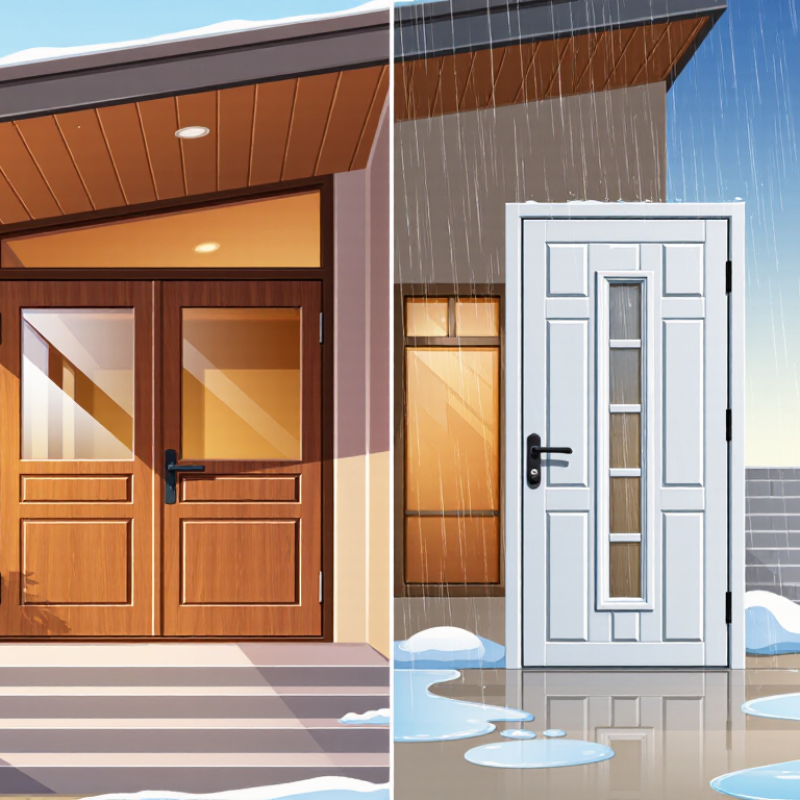
Choosing a home door starts with the hazard outside your address. FEMA flood maps, local wind zones, and the adopted International Residential Code can change the right specification. Check the local building department before ordering.
In hurricane-prone areas, select doors tested for wind pressure and windborne debris impact. Look for documented testing under recognized standards, such as ASTM E1886 and ASTM E1996, when local requirements call for them. Strong hinges, reinforced frames, and properly anchored fasteners matter as much as the door slab. A beautiful impact-rated door can still fail if installers use short screws. That detail is often missed.
Flood exposure requires a different approach. FEMA guidance generally favors elevation and minimizing enclosed areas below the design flood elevation. A door should not become the weakest opening. Use corrosion-resistant hardware, sealed thresholds, and assemblies approved for the expected water conditions. Some flood-resistant doors may require engineering review, especially in coastal or high-velocity zones. ICC codes provide model requirements, but your jurisdiction may amend them. Ask for the adopted edition, not a generic code claim.
Cold climates also test doors through air leakage and repeated freeze-thaw cycles. Choose insulated cores, durable weatherstripping, and frames suited to local moisture. I have seen homeowners focus on glass strength while ignoring sill drainage. That is a costly oversight. No checklist is perfect. Soil movement, poor installation, and aging seals can still reduce protection. Keep the product label, test reports, permits, and installation records together. Inspect the door after severe weather, even when it looks fine.
Choosing the best home door for any climate begins with installation, not appearance. A high-performance door can still leak air if the frame is twisted or poorly sealed. In humid regions, inspect the sill pan and drainage path carefully. In cold areas, check the U-factor and look for continuous insulation around the frame. Hot climates may benefit from a lower solar heat gain coefficient, especially on sun-facing entrances.
AAMA standards offer useful installation and performance references for weather resistance, air leakage, and structural strength. Ask the installer which test requirements apply to your door and climate. ENERGY STAR guidance can also help compare efficiency ratings, but ratings alone cannot fix careless workmanship.
The frame should be level, plumb, and square. Fasteners need proper spacing. Shims should support the frame without forcing it out of shape. Small gaps matter.
Tips: Run a thin smoke pencil around the closed door on a windy day. Watch for movement or a broken smoke trail. Confirm that flashing overlaps correctly, and photograph hidden layers before interior trim is added. Request written details for sealants, insulation, and water testing. A short inspection is worthwhile. I have seen attractive doors fail because the threshold was slightly tilted. That mistake is easy to miss, and harder to repair later. Recheck the door after heavy rain and seasonal temperature changes; buildings move, and installation quality may reveal itself slowly.