Choosing the best automatic doors for your business is not simply a matter of appearance. It is a practical decision involving safety, accessibility, traffic flow, energy use, and long-term maintenance. A busy supermarket needs a different entrance from a quiet medical clinic. A hotel may value smooth, silent movement, while a warehouse needs stronger controls and faster opening cycles.
Ron Mace, a leading accessibility and universal design expert, described good design as being “usable by all people.” That short idea matters when selecting automatic doors. Customers may arrive with shopping carts, wheelchairs, luggage, or wet umbrellas. Employees may pass through dozens of times each hour. The entrance should respond without hesitation, yet it must not open unnecessarily during cold or hot weather.
Look closely at the details. Measure the doorway width. Watch the busiest ten minutes. Check whether sensors detect children, slower pedestrians, and people approaching from an angle. Ask who will inspect the system and how quickly replacement parts can arrive. These questions often reveal more than a polished product brochure.
I have seen businesses choose the cheapest option and regret it after repeated sensor failures. That choice can be understandable. It is not always wise. A reliable supplier, qualified installation, clear safety testing, and scheduled servicing should influence the decision as much as the purchase price. The first choice may still need adjustment. Buildings change, traffic changes, and customer needs change. Good automatic doors should accommodate those realities rather than create new obstacles.
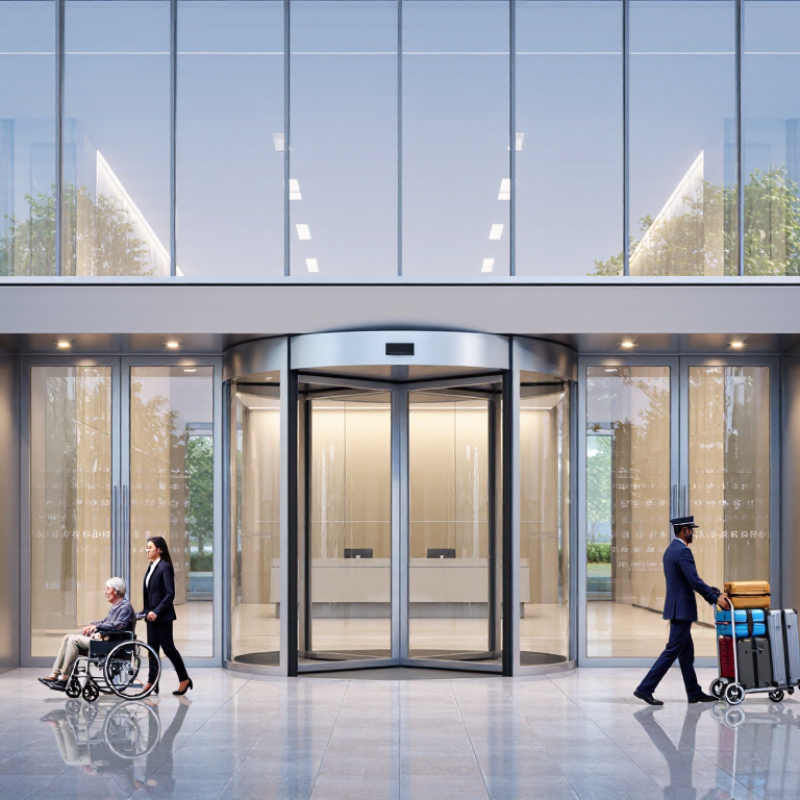
Choosing an automatic door starts with the building’s daily rhythm, not the door’s appearance. In a site assessment, record peak traffic by hour, visitor types, trolley sizes, and available floor space. A clinic entrance may need quiet, touch-free operation for patients and staff. A warehouse may need faster opening cycles and stronger impact protection. Small details matter. A delivery cart can expose a narrow clearance problem within one afternoon. Ask who uses the entrance, how often, and under which conditions.
Match the application to the door design. Sliding doors suit busy retail entrances when the opening area is limited. Swing doors can work well in offices with controlled traffic and clear approach space. Revolving doors may reduce drafts in large public lobbies, but they need careful accessibility planning. Consider wind, rain, dust, temperature changes, and emergency egress requirements. Sensors should detect slow-moving users, mobility aids, and children. Never judge safety from a showroom demonstration alone. Test the door with real traffic patterns.
Budget for installation, inspections, cleaning, and replacement parts. Reliable performance depends on all four. Ask the installer to explain maintenance intervals and failure procedures in plain language. A manual release should be easy for trained staff to locate. I have seen plans focus on opening speed while ignoring queue behavior. That mistake can create bottlenecks near reception desks. Review the layout after installation, too. Business needs change, and the original choice may need adjustment.
| Business Need or Application | Recommended Automatic Door Type | Typical Clear Opening | Typical Traffic Capacity | Activation Method | Typical Operating Speed | Accessibility and Safety Considerations | Key Planning Factors |
|---|---|---|---|---|---|---|---|
|
High-volume public entrance Shopping centers, supermarkets, airports, and major public buildings |
Automatic sliding door |
Approximately 900–2,400 mm wide per opening Approximately 2,000–2,500 mm high |
High; suitable for continuous two-way pedestrian flow | Microwave or infrared presence sensors, push plates, access-control readers, or remote controls | Commonly about 0.2–0.7 m/s, depending on the operator, door size, and safety settings | Provide a clear passage of at least 815 mm where the applicable accessibility code requires a 32-inch minimum clear width. Use presence sensors and monitored safety devices to reduce the risk of contact. | Available wall space, wind exposure, energy loss, emergency egress requirements, and the expected number of opening cycles |
|
Limited entrance space Offices, clinics, restaurants, and small retail premises |
Automatic swing door |
Approximately 800–1,200 mm wide per leaf Common single-leaf sizes are around 900–1,100 mm wide |
Low to medium; generally suitable for controlled pedestrian flow | Push plates, elbow switches, touchless sensors, access-control systems, or keypad devices | Commonly about 0.2–0.5 m/s, with adjustable opening and closing speeds | The door must be coordinated with the approach area, swing path, and accessible route. Low-energy operation is often used where slower, controlled movement is preferred. | Door swing clearance, adjacent walls, corridor width, latch hardware, fire-rating requirements, and manual opening force |
|
Hands-free service areas Hospitals, laboratories, food-preparation areas, and warehouses |
Automatic sliding or hermetic sliding door |
Approximately 900–1,500 mm wide Specialized hermetic systems may use larger or smaller openings according to room design |
Medium to high, depending on the facility and door configuration | Hands-free presence sensors, foot switches, push plates, badge readers, or building-management controls | Commonly about 0.2–0.6 m/s; controlled speed is preferred in clinical and clean environments | Use safety sensors, controlled closing, smooth surfaces, and suitable seals where hygiene or pressure control is important. Confirm infection-control and fire-code requirements. | Cleaning chemicals, pressure differentials, air leakage, noise, sanitation procedures, and the required level of environmental separation |
|
Maximum weather protection Hotels, premium offices, transit terminals, and buildings with strong outdoor exposure |
Automatic revolving door |
Typical diameter of approximately 1,800–3,600 mm Exact capacity depends on the number and size of door wings |
Medium to high, with continuous directional flow | Presence sensors, entry sensors, speed monitoring, emergency stop devices, and access-control systems | Commonly about 0.2–0.8 revolutions per minute; speed is normally limited for safety | Requires clear emergency egress arrangements and suitable safety sensors. A separate accessible swing or sliding door may be required by local regulations. | Building frontage, floor loading, ceiling height, cleaning access, emergency exits, wind conditions, and available installation diameter |
|
High-traffic entrance with a narrow footprint Retail stores, commercial buildings, and interior connections |
Automatic folding door |
Approximately 1,200–2,400 mm wide Often selected where a sliding door cannot provide sufficient stacking space |
Medium; suitable for frequent but not necessarily continuous traffic | Infrared motion sensors, presence sensors, push plates, or access-control devices | Commonly about 0.2–0.6 m/s, depending on panel weight and opening width | Use monitored safety sensors and ensure that the folded panels do not obstruct the accessible route or required exit width. | Limited side-room, panel stacking area, wind pressure, noise, floor levelness, and maintenance access |
|
Controlled employee or tenant access Office buildings, apartment lobbies, industrial facilities, and secure back-of-house areas |
Automatic swing or sliding door with access control |
Commonly 900–1,200 mm wide Larger openings may use paired sliding leaves |
Low to medium, based on the number of authorized users | Card readers, mobile credentials, PIN pads, biometric readers, exit sensors, or request-to-exit devices | Commonly about 0.2–0.6 m/s, with slower settings available for security and accessibility | Access control must not prevent code-compliant emergency exit. Provide manual-release or emergency-unlocking functions where required. | User permissions, power-failure behavior, battery backup, network integration, audit records, and security level |
|
Low-energy accessibility priority Senior-care facilities, public offices, schools, and small businesses |
Low-energy automatic swing door | Approximately 815–1,200 mm clear opening, depending on the door leaf and local code | Low to medium; designed for controlled operation rather than rapid throughput | Push plates, accessible switches, low-force contact sensors, or supervised wireless controls | Commonly about 0.1–0.3 m/s, with adjustable opening and closing times | Supports users who may need more time to pass through. Confirm opening force, closing force, maneuvering clearances, and accessibility requirements for the jurisdiction. | User mobility, door weight, approach surface, weather exposure, manual-use frequency, and power supply |
|
Vehicle and pedestrian separation Distribution centers, factories, loading areas, and service entrances |
Automatic industrial sliding or high-speed fabric door | Pedestrian doors commonly range from 900–1,200 mm wide; vehicle openings are often 2,400–6,000 mm wide or larger | Medium to very high, depending on vehicle and pedestrian movement | Radar, induction loops, photoelectric sensors, pull cords, remote controls, or industrial access-control systems | High-speed models commonly open at approximately 0.8–2.5 m/s; verify the selected system's rated speed | Use separate pedestrian access wherever possible. Provide safety edges, photoelectric protection, warning signals, and emergency release systems appropriate to the environment. | Vehicle dimensions, impact risk, dust, temperature, wind load, wash-down conditions, cycle frequency, and maintenance capability |
|
Energy-efficiency improvement Climate-controlled buildings with frequent outdoor door use |
Automatic sliding or revolving door with vestibule strategy | Sliding openings commonly range from 900–2,400 mm wide; revolving-door diameter is commonly 1,800–3,600 mm | Medium to high, depending on the entrance configuration | Motion sensors, presence sensors, access control, and scheduled operating modes | Sliding doors commonly operate at about 0.2–0.7 m/s; revolving doors rotate at controlled low speed | Safety sensors and emergency egress provisions remain essential. Energy performance depends on building pressure, door exposure, sealing, and operating settings. | Heating and cooling loads, local climate, vestibule depth, air infiltration, wind exposure, maintenance, and opening frequency |
 Automatic Doors, Inc.